
Trees and palms on Honolulu lots
Tree Service in Honolulu, HI
Trimming, removal, palm work and storm cleanup, planned around trade winds, wet valleys, tight lots and the rules for street and exceptional trees.
- We price jobs standing in your yard, anywhere in Honolulu and the south shore of Oʻahu
- Written estimate with each job priced separately
- Chips, logs and brush plan made at the estimate
Tree Work for a City Between the Mountains and the Sea
Tree service in Honolulu covers more ground than most people expect in one city. Near the coast the climate is semi-arid: the airport averages about 16 inches of rain a year, most of it between October and early April. A few miles inland, Mānoa Valley gets rain almost every day, even in the dry season. A monkeypod in Kāhala, a mango on a Kalihi hillside and a stand of albizia at the back of a Pālolo lot grow at different speeds, fail in different ways and need different plans. Our work is about reading each tree and each lot correctly before anyone climbs.
What August 2026 taught Honolulu about its trees
When Lala passed the islands in mid-August 2026, the Honolulu Fire Department logged 147 reports of downed trees on Oʻahu by noon on Sunday, and the city later counted about 500 calls for tree debris removal. The trees that failed were a familiar list: albizia, with shallow roots and brittle branches; royal poinciana and eucalyptus, with brittle wood; yellow poinciana squeezed into small planting spaces; a century-old banyan at Punahou Square in Makiki; and ironwoods near Kapiʻolani Park. Rain had saturated the soil first, and trees planted in narrow strips lifted out of the ground. Earlier in 2026, Kona low storms had already knocked down large trees around the island.
The lesson for homeowners is not that every big tree should go. It is that the problems usually show before the storm: a heavy limb over the roof, two trunks splitting from one base, a canopy that has never been thinned, or a fast-growing albizia that was a sapling a few years ago and now stands taller than the house.
Palms and the coconut rhinoceros beetle
Coconut palms are part of almost every Honolulu yard, and they need more regular attention than shade trees. The Aloha Arborist Association's guidelines call for pruning coconut palms at least twice a year in developed areas, so that nuts and dead fronds do not fall on people, cars or roofs. Coconut rhinoceros beetle, first detected at Joint Base Pearl Harbor-Hickam in December 2013, has since damaged thousands of coconut palms on Oʻahu. Adult beetles bore into the crown to feed, new fronds can break as they open, and a palm can die if the growing point is damaged. Because beetles breed in green waste, mulch and rotting palm stumps, the state restricts how that material moves on Oʻahu and requires it to be covered in transport.
Street trees, exceptional trees and power lines
Two city rules come up often. Trees in the planting strip between the curb and your property line are street trees, and pruning, spraying or removing one without a permit from the Department of Parks and Recreation is unlawful. Trees on the city's Register of Exceptional Trees, chosen for history, age, rarity, size or endemic status, need an approved permit before crown or root pruning. We flag both before quoting. For lines, Hawaiian Electric says homeowners are responsible for trees affecting the service line to their house, and the utility can de-energize and lower that line on request so the tree can be worked safely.
What an estimate visit covers
- Each tree or palm: species, lean, dead wood, cracks, co-dominant stems and decay
- What lies underneath: roof, lanai, carport, walls, the neighbor's yard and the street
- Service lines and whether Hawaiian Electric needs to be called first
- Access on slopes, steps and narrow side yards
- Whether the tree may be a street tree or a registered exceptional tree
- What happens to fronds, logs, chips and the stump
- A written price for each tree, with nothing added without your approval
Towns Around Honolulu
Honolulu is the center of our work, and the city itself is several different places for trees. Kalihi, Pālama, Moanalua and Salt Lake have older homes on hillsides and in former tuff cones, with mango and breadfruit in back yards. Makiki, Mānoa, Nuʻuanu and Pālolo sit in wetter valleys and on ridges, where trees grow fast and access can be steep. Kaimukī, Kapahulu and the streets below Diamond Head are drier, with tighter lots and lines running through the canopy. Kāhala, ʻĀina Haina, Niu Valley and Hawaiʻi Kai have larger yards, more palms and more salt air. Beyond the city we also work in nearby communities along the south and windward shores. What stays the same everywhere is the need to check for street trees, exceptional trees and service lines before any cutting, and each area page covers what we know about that place.
- Tree Service in Honolulu, HI
- Tree Service in Kailua, HI
- Tree Service in Kaneohe, HI
- Tree Service in Aiea, HI
- Tree Service in Pearl City, HI
- Tree Service in Mililani Town, HI
- Tree Service in Mililani Mauka, HI
- Tree Service in Kapolei, HI
- Tree Service in Ewa Beach, HI
- Tree Service in Ewa Gentry, HI
- Tree Service in Waipahu, HI
- Tree Service in Waipio, HI
- Tree Service in Wahiawa, HI
- Tree Service in Waimanalo, HI
- Tree Service in Makakilo, HI
- Tree Service in Royal Kunia, HI
- Tree Service in Halawa, HI
- Tree Service in Ahuimanu, HI
- Tree Service in Kahaluu, HI
- Tree Service in Hawaii Kai, HI
- Tree Service in Manoa, HI
- Tree Service in Kahala, HI
- Tree Service in Nuuanu, HI
- Tree Service in Haleiwa, HI
Our Tree Services
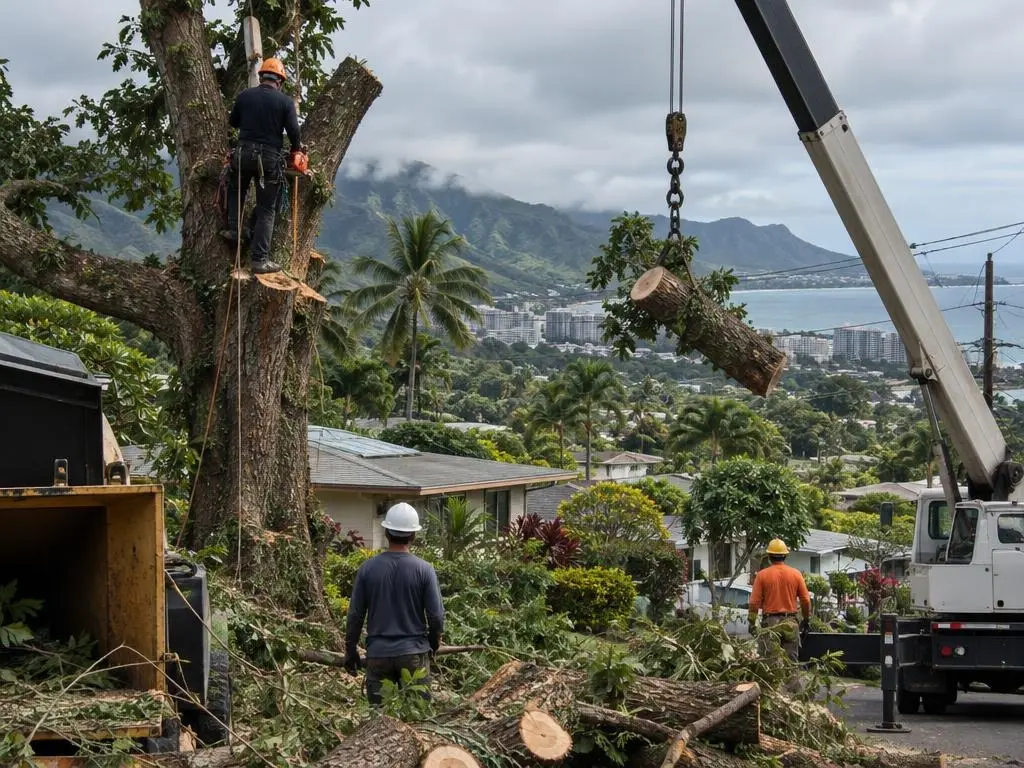
Six services cover most tree and palm work on Honolulu homes, from a twice-a-year coconut trim to taking down a storm-split monkeypod.
Tree Removal
Dead, storm-split, oversized and unwanted trees taken down in sections on tight Honolulu lots.
Learn more →Tree Trimming & Pruning
Thinning, reduction and clearance pruning that keeps shade trees healthy and off roofs, walls and lines.
Learn more →Palm Tree Trimming
Coconut and ornamental palms cleaned of nuts, dead fronds and flower stalks, with beetle damage checked.
Learn more →Stump Grinding
Tree and palm stumps ground below grade, with the chips backfilled or hauled.
Learn more →Emergency Storm Tree Service
Trees and limbs on roofs, cars, lanais and driveways cleared after Kona lows, tropical storms and trade-wind gusts.
Learn more →Hurricane Prep Pruning
Weight reduction, deadwood removal and palm cleanup before the June-to-November season and winter Kona lows.
Learn more →Common Questions
How much does tree service cost in Honolulu?
It depends on the tree's height, what it hangs over, access and how much wood has to be hauled. Homeyou's October 2026 Honolulu guide puts removal of a medium tree at about $778 to $1,046, and LawnStarter lists Honolulu averages of about $403 for trimming and $730 for removal. Coconut palm trims usually cost less than a shade tree. We give a written price after seeing the tree.
Do I need a permit to cut down a tree on my own property in Honolulu?
The city's tree rules center on two groups: trees on the city's Register of Exceptional Trees, which need an approved permit before pruning, and street trees in the planting strip by the curb, which need a Department of Parks and Recreation permit. The Division of Urban Forestry at (808) 971-7151 can confirm a tree's status.
Who trims a tree that is touching the power line to my house?
Hawaiian Electric says homeowners are responsible for trees on their property near the service line and for damage those trees cause to it. The utility can de-energize and lower the service line on request so the tree can be worked on safely; call (808) 543-7836 on Oʻahu before anyone works within 10 feet of the line. Lines along the street are trimmed by the utility's own crews.
How often should coconut palms be trimmed in Honolulu?
The Aloha Arborist Association's guidelines call for coconut palms in developed areas to be pruned at least twice a year, mainly so nuts and dead fronds do not fall on people and property. Palms over walkways, driveways, lanais or a neighbor's yard are the priority. Healthy green fronds above horizontal should stay on the tree.
What are the signs of coconut rhinoceros beetle in my palm?
Adult beetles bore into the crown, so look for new fronds that break or fall as they open, damaged fronds and holes near the top of the palm. Infestations can kill a palm if the growing point is damaged. If you suspect it, the state's CRB response line is (808) 679-5244, and green waste from the palm should be kept covered when it is moved.
Can a tree company take my green waste, or do I use the green cart?
Either works, depending on volume. The city's green cart takes pieces cut to fit with the lid closed, and convenience centers and transfer stations accept green waste with load limits. For a full trim or removal, hauling is usually included in the quote, and the material is moved covered to an approved green waste site.
Is there a tree company near me that can come out after a storm?
We work across Honolulu and nearby south shore and windward communities, and after a storm we take calls in order of danger: trees on roofs, blocked exits and limbs on vehicles first. If a tree is on a power line, stay clear and call Hawaiian Electric or 911. You can call (808) 746-9674 any time to leave details and photos.
Why Homeowners Call Honolulu Tree Service Pros
A plan written before anyone climbs
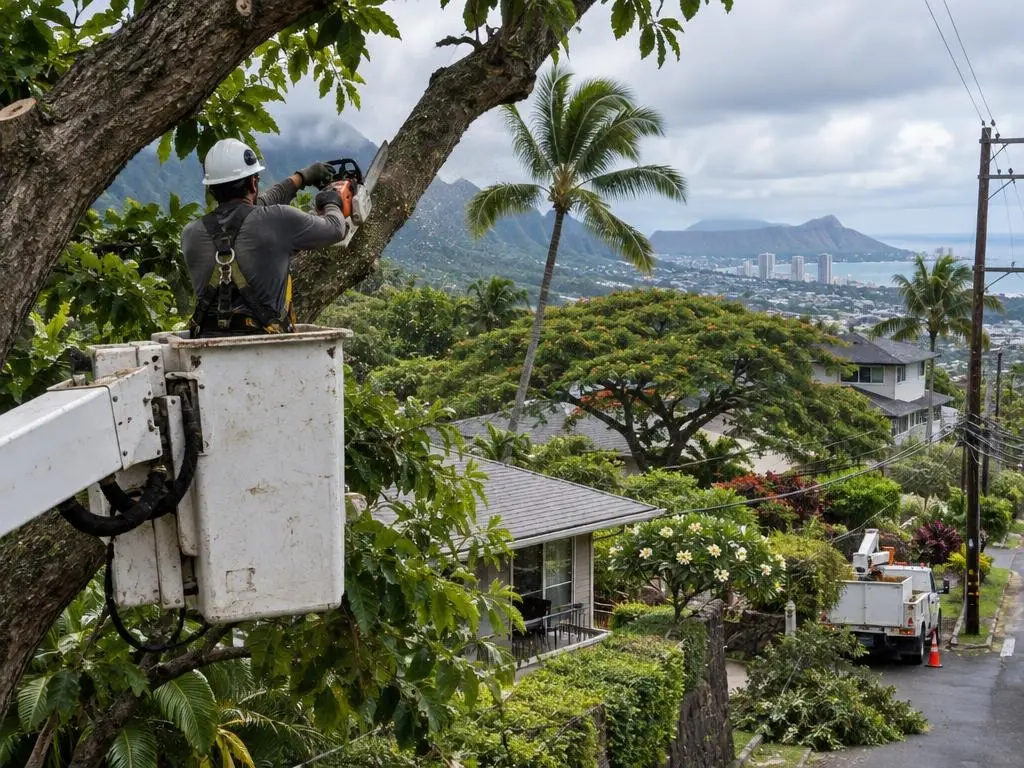
The quote says how each tree or palm will be cut back or taken down and what underneath it needs protecting, so you know what to expect on the day.
Pruning to the standard
We prune to ANSI A300: thinning and reduction cuts, with no topping and no lion's-tailing, which weaken trees and invite brittle regrowth.
Rules checked first
We check for street trees, registered exceptional trees and service lines before quoting, and tell you who to call if a permit or the utility is needed.
Green waste handled right
Palm fronds, branches and chips are hauled covered, as the state's coconut rhinoceros beetle rules require for green waste moving on Oʻahu, or left for you if you prefer.
Book a Free On-Site Estimate
Free on-site estimates in Honolulu, with a written quote for every tree and palm.